
Smart Factories in Practice: What Industry 5.0 Actually Changes
Industry 4.0 promised the lights-out factory; what most manufacturers got was a collection of pilots — a digital twin here, a predictive maintenance proof of concept there — and a measurable gap between leaders and laggards. Industry 5.0 reframes the goal: resilient, sustainable, human-centric production, where technology amplifies skilled operators instead of aspiring to remove them.
What the leaders actually did
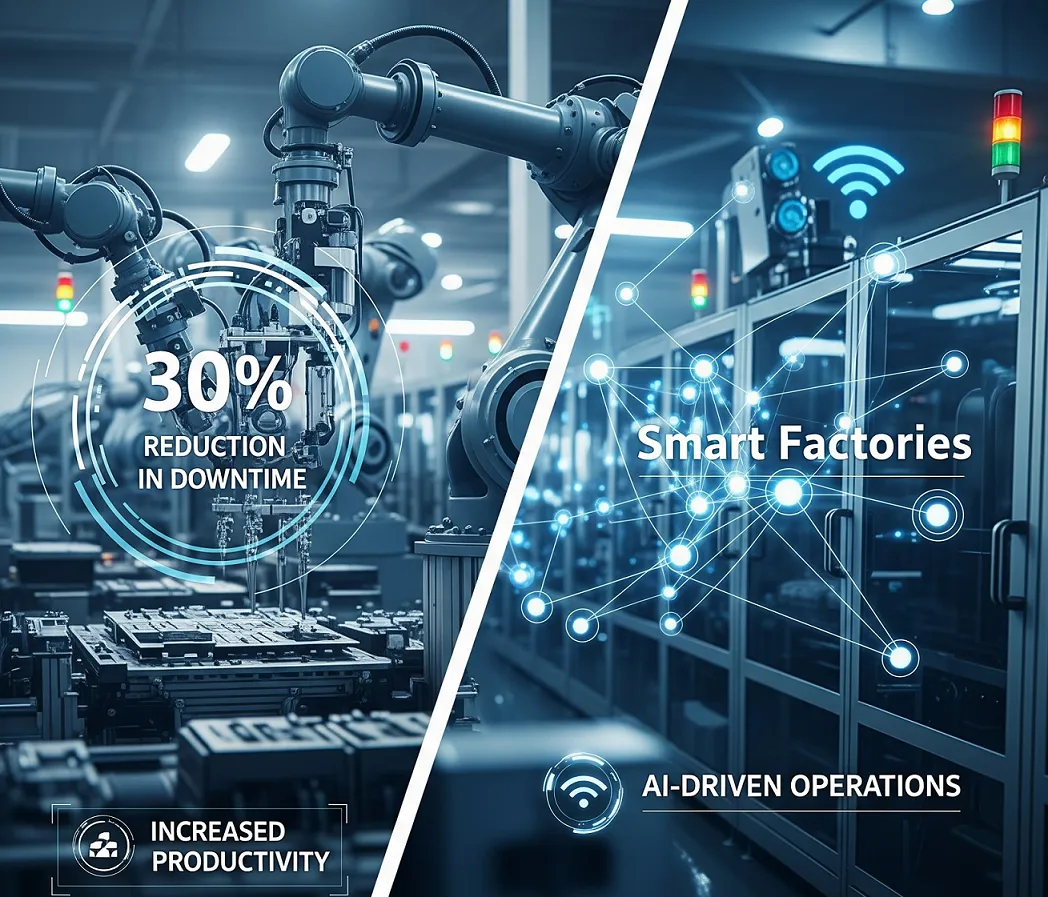
The manufacturers reporting 30%+ downtime reductions and double-digit productivity gains share an unglamorous discipline:
- **Connectivity before intelligence.** They instrumented critical assets and unified OT and IT data first — no AI model can optimise a line it cannot see.
- **One line, end to end.** Instead of ten pilots across ten plants, one production line digitised completely — sensors, twin, analytics, operator tools — producing a reference implementation that scales with credibility.
- **Operators as users, not obstacles.** Interfaces designed with the people on the line, surfacing the next best action rather than dashboards nobody asked for. Adoption follows usefulness.
- **Maintenance as the entry point.** Predictive maintenance remains the most reliable first ROI: unplanned downtime is expensive, the data exists, and the payback funds the next wave.
The 2026 pressures making it urgent
Energy costs and ESG reporting obligations are turning efficiency into compliance; demographic shifts are draining experienced operators faster than they can be replaced — making knowledge capture in systems, not heads, existential; and supply volatility rewards plants that can reconfigure quickly.
The smart factory is not the one with the most robots. It is the one where data, machines, and experienced people compound each other shift after shift.
Where Ganexa can help
Ganexa's Manufacturing practice combines Smart Factory Transformation, Predictive Maintenance Analytics, and ERP/MES/PLM integration into a sequenced roadmap — anchored by our IoT Platforms & Integrations and Data Strategy work. We start where the ROI is provable and scale on evidence, with ESG-aligned supply chain restructuring when you are ready for the next horizon.